Risk or uncertainty
What is the difference between pretending you know, and being able to carry uncertainty?
We like to treat uncertainty as a risk. We analyse, we model, we cover ourselves. Only: with real uncertainty it is precisely the missing variables that are decisive. Eisenhower already knew: plans are worthless, but planning is everything.
Frank Knight sharpened that distinction in 1921. Risk you can calculate, spread and insure: the variables are known. Uncertainty is something else. There the framework itself is still moving, and the rules shift while you play. You simply do not know what you do not know.
I notice it in nature, where I guide groups. On a via ferrata, a steep rock you climb with a steel cable and iron rungs, it looks dangerous, and yet the risk is manageable: lifelines that always stay clipped in, people who secure each other on the rope, training and experience. We know the risks and can absorb them. Against uncertainty you cannot simply clip in a second lifeline. You have to carry it.
The shouting goose and the puffed-up hedgehog
Seeking risk is something other than carrying uncertainty. Two figures stand in the way of carrying it.
The goose makes himself big, shouts the loudest and rushes forward. He acts as if he already knows the outcome, as if he owns a crystal ball. People like to follow whoever radiates a lot of certainty, and that is exactly where the danger lies. That bravado does more damage than the risks themselves. You see it in abundance in today’s political leaders. Geopolitics quickly becomes ego-politics, as Koen Schoors aptly put it at Het Nieuwe Normaal.
The hedgehog rolls up and no longer moves, precisely because it gets tense. Earlier I called that action paralysis, in A new normal, strong morale. One acts as if he knows everything, the other no longer dares anything. Neither of them carries the uncertainty.
The leader does not need to know the future. He has to stand firmly enough to stay present while nobody knows it.
That is where the gain lies too. Knight already saw it: it rewards not whoever takes the most risk, but whoever can carry uncertainty without certainty of success. Value arises precisely where others become falsely certain or fall silent. Sometimes very concretely: an assignment, a market, a future that opens up because you kept moving.
What makes movement possible
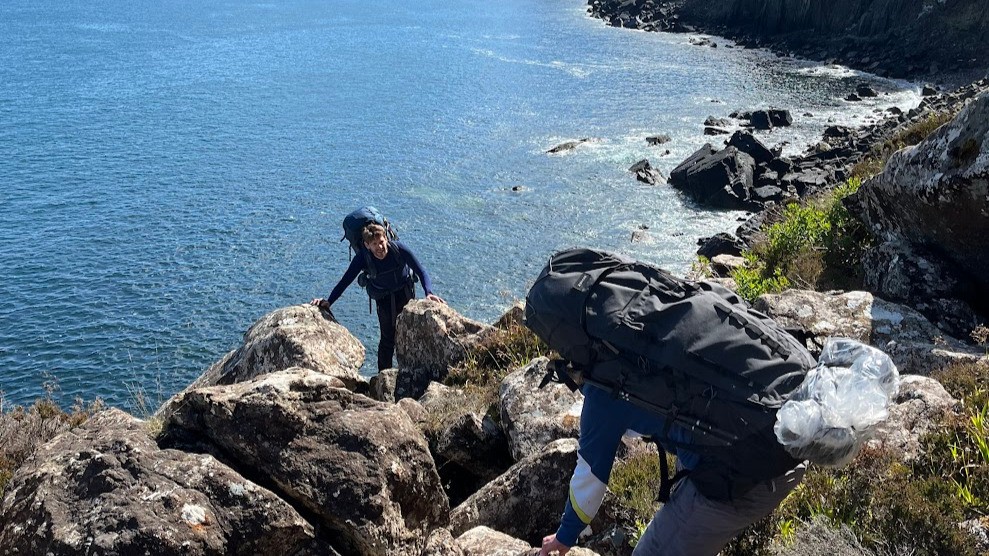
Last month I walked the Skye Trail in Scotland, with two good friends. At one point we wanted to leave the well-trodden path and explore something new ourselves. Straight up, over steep rocks with loose stones, to the top of the cliffs, a route that nobody seemed to have gone before us. Tempting and uncertain. The alternative was the long way round, the path we already knew.
One friend stopped and dared to say it did not seem feasible to him. We only went further once we had put frameworks around it. Everyone had to be on board, otherwise we would not do it. We could say stop at any moment. And we never went so far that we could not go back. The way back always stayed open.
Only with those agreements did the three of us dare to go the steep way.
Limits and a back door do not limit daring. They make it possible. It is like a right to pass: the more explicitly you give it, the fewer people need it.
Shouting “just try” from a comfortable chair sounds generous, but it is empty. Whoever goes through a passage easily does not always see where another gets stuck. Their example only helps when they understand what support the other needs. Outside you quickly see whether support is real support.
Leadership is bringing what the group is missing at this moment.
Sometimes that is an opening. And sometimes focus. Sometimes a limit. Or sometimes room. The point is not that you do the opposite. The point is that you see what is missing.
Carrying means daring to give direction while you are still searching yourself, and adjusting as soon as your assumptions no longer hold. Sometimes the new path that seemed feasible turns out to be too steep or too costly. Then you turn back, or take the way you kept open. That is not failing. It is carrying.
You do not have to tell people how. They know that themselves. You give direction, and you stay with them while they find their way.
Everyone with a healthy ego, me included, knows the feeling of your own view narrowing. That is the moment to stand still and notice what is happening. Only then can you see what a group is missing, and organise enough firmness to move again with appetite.
Stay Human.
I am Kobe. I trained as a psychologist. As director of a reception centre for refugees at Fedasil, as a trainer and consultant in Ethiopia, and now as Executive Director of Outward Bound Belgium. What drives, connects and sometimes holds people back: that is what I like to stay curious about. From boardroom to rock face, the common thread in my life is how we can remain human in a world that is spinning out of control.
Sources
Frank Knight, Risk, Uncertainty and Profit. Houghton Mifflin, 1921.
Geert Janssens, Eeuwig Ondernemen. Etion. (source of the Knight framework)
Dwight D. Eisenhower, Remarks at the National Defense Executive Reserve Conference, 14 November 1957.
Koen Schoors, lecture at Het Nieuwe Normaal, Outward Bound Belgium, 2026. https://het-nieuwe-normaal.be