Thrive Talents is the program for organisations that give talent, at crucial moments, a learning environment that makes the difference — and see that investment return in people who land faster, stay longer and contribute more.
Thrive and Elevate are not separate products — they form a learning ladder. Thrive lays the foundation: self-knowledge, collaboration and first responsibility. Elevate builds on that for those who formally carry leadership. Many organisations use both as part of a multi-year talent policy.
Meaningful when
An intake group wants to live the culture and values, not just understand them
Talent is taking the step to a first leadership role or key position
The organisation wants to invest in retention and career perspective
A cohort wants to learn together and form a peer community
Less suitable when
There is no room to free up the outdoor module from
work
The focus is on team dynamics in an existing team → Unite Teams
The focus is on senior leadership and decision-making → Elevate Leaders
Thrive works at two clearly distinct moments.
Each has its own dynamic and its own logic.
Intake & Onboarding
01
Talent that joins and needs to land. New employees, high potentials at the start, cohorts at intake. They are strong in their field, but still have to land: in the culture, in their role, in a peer community that will surround them for years. Thrive turns an intake group into a cohort that learns together.
Career acceleration
02
Proven talent that wants to take on leadership. Employees with 3 to 8 years of experience who are ready for their first real responsibility — and need to grow beyond their own field. They are not looking for training. They are looking for a context that challenges them beyond what they already know.
Thrive works for cohorts of at least six participants. The program connects to your intake or progression moments.
What it costs if you don't use this moment
The most expensive patterns are not always the most visible. These are the signals that HR directors and managers recognise.
Talent leaves in year 2 or 3
Just when the investment in recruitment and onboarding starts to pay off. Not through a lack of challenge, but through a lack of connection and perspective.
Lack of community
No peer community forms. People work next to each other and miss the informal networks that would later make them strong.
Values without experience
New employees know the values and culture, but have not lived them. They do not yet speak the language from the inside.
Collective memory loss
The same mistakes keep coming back. Knowledge and experience are not passed on — every generation starts over.
What visibly changes
This is what managers and HR teams see differently in participants' behaviour after Thrive — regardless of the point of entry.

Ownership & Initiative
People wait less. They make decisions within their own domain, contribute ideas and adjust their agenda based on what they encounter in practice.
Self-knowledge & Direction
People know better what they want and what they are good at. They make more conscious choices about how they make their contribution.
Collaboration & Feedback
Participants speak more directly. They ask for help sooner, give feedback and involve others in their thinking.
Resilience under pressure
Participants deal differently with uncertainty and setbacks. They learn to adjust sooner rather than persist in what does not work.
Connection with the organisation
Talent does not just understand the values and culture — they have lived them. That creates a commitment that lasts longer than a welcome day ever could.
A peer community that stays
The cohort forms a group that keeps learning from and with each other after the program. They recognise each other's
challenges and support each other — even years later.
Participant
BAM explore
How people learn here
The learning logic and the outdoor module are proven and repeatable. The content connects to your organisational context, values and objectives. Not a standard program — but a framework that works.
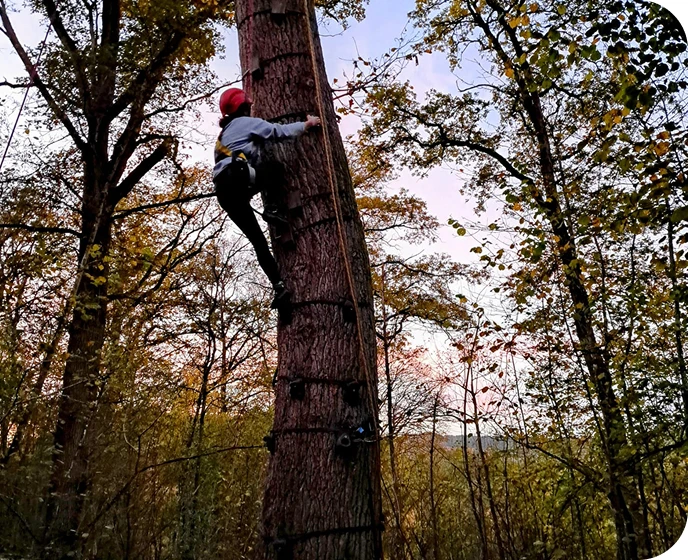
The core is a residential stay at Château Varoy — two to three days outside the office environment. Participants are brought into situations that really ask something of them: collaboration under pressure, choices with consequences, visibility to themselves and to each other.
The learning logic: ME — YOU — WE.

How a program is built
Onboarding
01
Alignment with HR and management: objectives, cohort profile and fit with your talent logic.
Development sprint
02
Residential experiential learning @ Château Varoy. Two to three days. The core of the program: ME — YOU — WE.
Transfer
03
Peer review. Insights are fed back into the work context.
Integration
04
Personal action plan and closing. What do I take with me? What changes in how I work and collaborate?
What organisations rarely say out loud to themselves: they have known for a long time what is causing friction. The names of the patterns are known to everyone close to them. But the context to make them discussable is missing.
Organisations that embed Thrive structurally in their talent policy differentiate themselves as an employer in
a way that touches candidates before they have even applied.
Retention rises. Engagement deepens. And the people who grow into key positions carry with them the culture they lived early on.

Why outside works
Outside the office environment, what people are willing to show changes. Daily work is not at stake, which makes people more open than in a meeting. At the same time, the context demands real choices and real collaboration, with consequences that are felt directly.
That is not a simulation. It is a learning environment that is both physically and psychologically safe, but leaves nothing to rationalise away. Behaviour becomes visible as it is. Patterns come to the surface without anyone being able to explain them away with agendas or roles.
That is why organisations come back for the next one after a first cohort.



Does your organisation have an intake or progression moment ahead?
In a one-hour conversation we look together at your cohort profile, intake or progression moments and how Thrive fits structurally into your talent policy.