Elevate Leaders is the program for leaders who explore how they really function — and what changes when they know.
Many leaders notice that decisions slow down, ownership shifts and conversations stay safe — while the context calls for more sharpness. Or that answers to issues are not clear, and the uncertainty this creates gets too little room.
This program has impact when these questions are current and there is willingness to give them time and attention.
Meaningful when
Leaders want to understand how their behaviour affects others
Tension, mandate or decision-making are on the agenda
The organisation is dealing with issues to which the answer is not immediately clear
The organisation makes time for real reflection and follow-up
Collaboration across functional lines is crucial
Less suitable when
Learning is not a priority in the organisation
Change is not carried by the top
There is no room for follow-up after the program
Who it is for
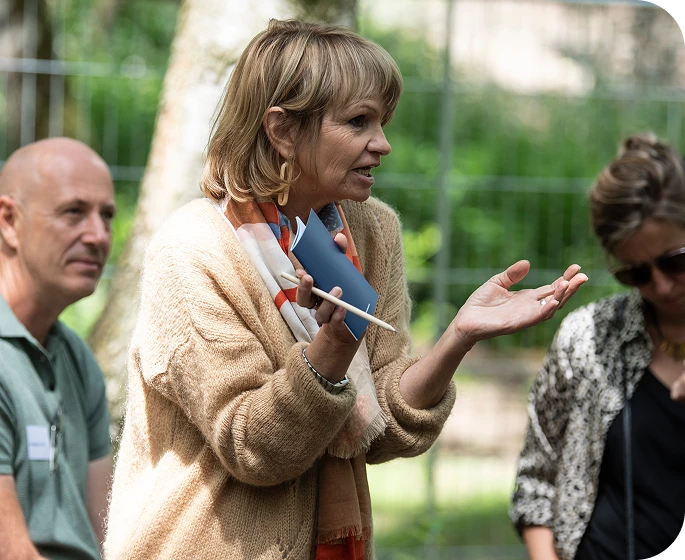
Elevate works with people who carry responsibility for strategy, culture and decision-making. Leaders who notice that giving direction takes more than position or expertise alone.
That applies in particular to those making the step from subject-matter expert to leader of people — from someone who knows things to someone who lets others work. That transition asks for something other than
knowledge.
For those who have been leading for longer but notice that certain patterns keep repeating, Elevate offers a different mirror than a coach or a management course can give.
Executive teams and C-level teams
HR directors and People leaders with decision-making mandate
Senior leaders and influencers in complex organisations
Boards and boards of directors
What we see in organisations
Leaders who choose Elevate usually recognise a number of recurring patterns
in themselves or their team.
What visibly changes
Organisations that recognise these patterns see a number of shifts over time — in meetings, in decision-making conversations, in daily collaboration.
In meetings
Less of one voice giving direction. More people formulating proposals themselves and building on each other. Conversations run more often through the team than through the manager.
Dealing with uncertainty
Less hurried decision-making to keep control. Teams take time to understand together what is going on — even when the answer is not immediately clear. Tension remains present, but no longer blocks the conversation.
Ownership
Fewer escalations upwards. More decisions are made within the team. Responsibility is shared and taken up, even when someone is absent.
Confrontation and feedback
Difficult matters are spoken out loud. Feedback becomes more direct. Tension leads to sharper choices instead of being avoided.
Reflection as a habit
Teams take moments to look back. They name what worked and what did not. Insights are carried into subsequent situations instead of starting over.
Vulnerability as strength
People dare to reach out, ask questions, involve others for their expertise. That increases not
only the connection — it also raises the quality of decisions.
Participant
INSEAD
How people learn here
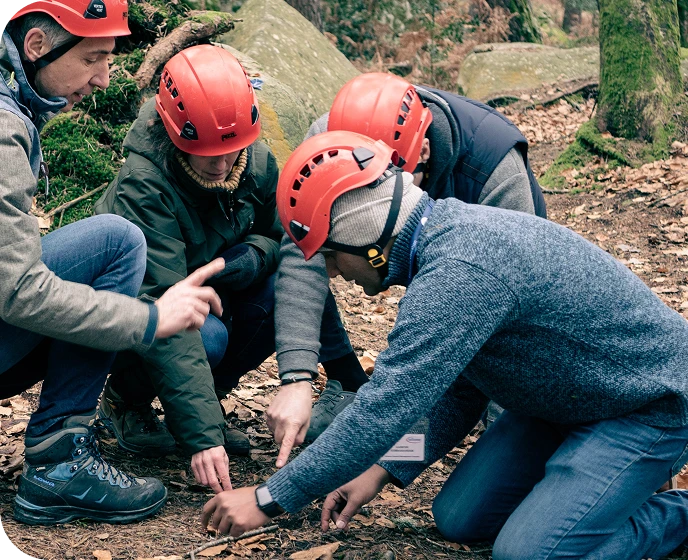
The core of Elevate is a residential module at Château Varoy — three to four days outside the office environment. Not as team building, but as a learning context.
We design situations in which people need each other, choices have real consequences and behaviour becomes directly visible — to themselves and to each other. Facilitators always start from the objectives of the organisation and of the leaders themselves. The themes, tensions and questions they bring are exactly the material we work with.
Facilitators name patterns. They do not prescribe them.
Nature offers what a meeting room cannot: focus, time pressure and distance from familiar roles. That makes discussable what would otherwise remain invisible.
How a program is built
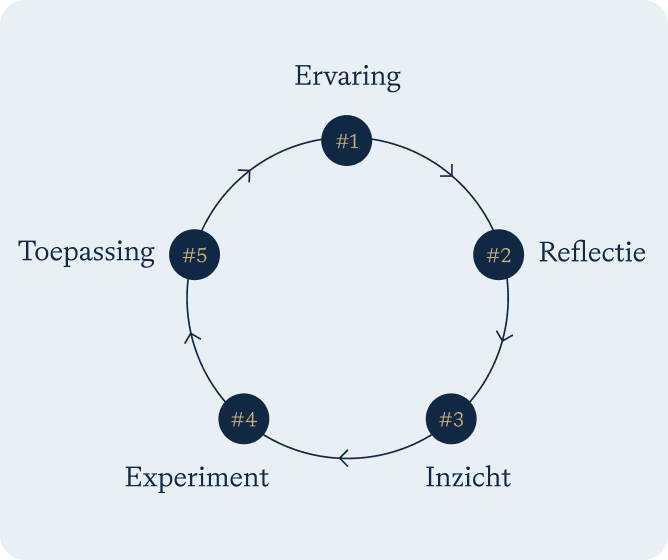
Onboarding
01
Individual intake. Sharpening of learning focus,
expectations and organisational context.
Development sprint
02
Residential experiential learning @ Château Varoy. The core of the program.
Bridge
03
Online coaching, theoretical deepening and peer sparring in small groups.
Focus weeks
04
Learning while you work. Insights are tested in the daily work routine.
Integration
05
What do I take with me? What concretely changes in my team and organisation? We take stock and anchor what was learned.
From multinationals to SMEs, from universities to social organisations.

Every program begins with
a conversation
Elevate always starts from your context, mandate and ambition. No standard formula. But a well-considered learning process that connects with what is really going on.
In this conversation we explore your context, where leadership gets stuck today,
and whether Elevate can be a meaningful lever.