Not in what people say about themselves. Not in a role play. In contexts where assumptions are tested, patterns become visible and behaviour develops from what is really going on.
Outward Bound Belgium brings people into those contexts — residential, outside the office environment, with facilitation that connects what people experience to what is going on in their organisation.
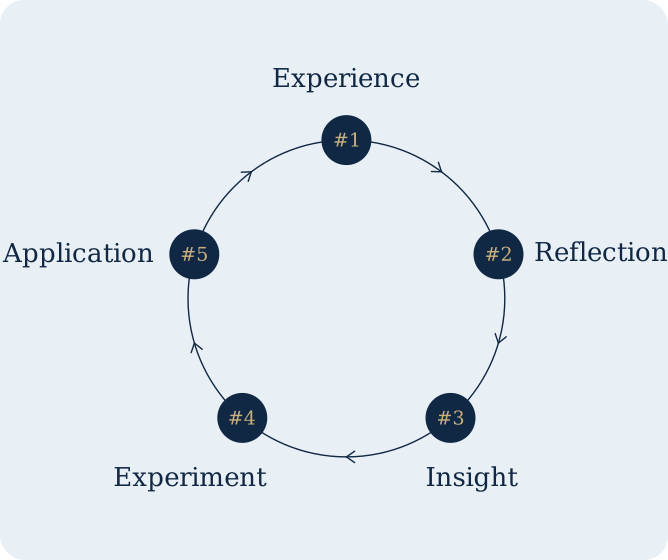
How the learning process unfolds
The learning logic is simple and powerful — and consistent in every program.
Facilitators work from the organisation's objective. They listen to what the group needs and choose what to give back. The themes, tensions and questions participants bring are the material we work with. The objective is fixed. The route towards it follows what presents itself.
Facilitators name patterns. They do not prescribe them.
What happens differently in a program
On a via ferrata, someone guides a colleague along a rock face. Whoever belays carries responsibility for whoever climbs. That is not an exercise in trust. That is trust.
In those situations it becomes visible who takes initiative, who withdraws, who says out loud what others think but don't say. After each experience, facilitators bring the group together to discuss what happened — not as outsiders reporting back, but as conversation partners who help name patterns together and connect them to what is going on in the organisation. The insight emerges within the group, not outside it.
That transfer is the point of the program — not the outdoor activities themselves.

In meetings
People who used to wait and see put forward viewpoints and defend them. Conversations run more often through the team. The manager has to pull less.
Around decisions
More decisions are made within the team, even when the manager is absent. Responsibility is shared instead of pushed upwards.
In collaboration
People know each other's way of working more precisely: who functions how under pressure, who takes initiative, who needs time to adjust. Alignment runs faster. Less noise, less
rework, fewer escalations.
Weeks later
Insights stick because they are linked to real experiences, not to theoretical frameworks. Teams return to what they went through together as a point of reference.
Participant
Bertelsmann PFO Program
Three axes, one blind spot
Teams work on three axes at the same time: what they achieve, how they collaborate, and who they are to each other. The three influence each other. Most organisations invest in the first axis. The other two get attention when something goes wrong.
Task
01
Goals, results, output. This is where most attention goes.
Process
02
How decisions are made, how information flows, how roles are divided.
Becomes visible when things go wrong.
Relationship
03
Trust, openness, knowledge of each other's way of working. Grows slowly and deteriorates quickly under pressure.
The blind spot is almost always in axis 2 and 3 — and that combination is exactly what an OBB program addresses.
Edgar Schein — Task, Process & Relationship
Amy Edmondson — Psychological safety
Johan Hovelynck — Experiential learning
What sets us apart

94%
facilitator effectiveness score,
rated by INSEAD
€9
social value per
euro invested (SROI)
2.500+
participants per year, more than
150,000 alumni
A conversation about your context
We work with organisations that want to change something about how their teams or leaders function — and are prepared to make time and context available for it.
Every program starts with an intake: what is going on, what does the organisation want to achieve, and what does a meaningful learning process look like in this context.